

SKU:FOS-26-0833
Shrimp Fossil
Shrimp Fossil
1 in stock
Couldn't load pickup availability
✔ Usually ready in 24 Hrs. View Store Information
Size: 7.5 X 1 X 6.5 cm
Weight: 96 Gram
Location: Germany
Product Description
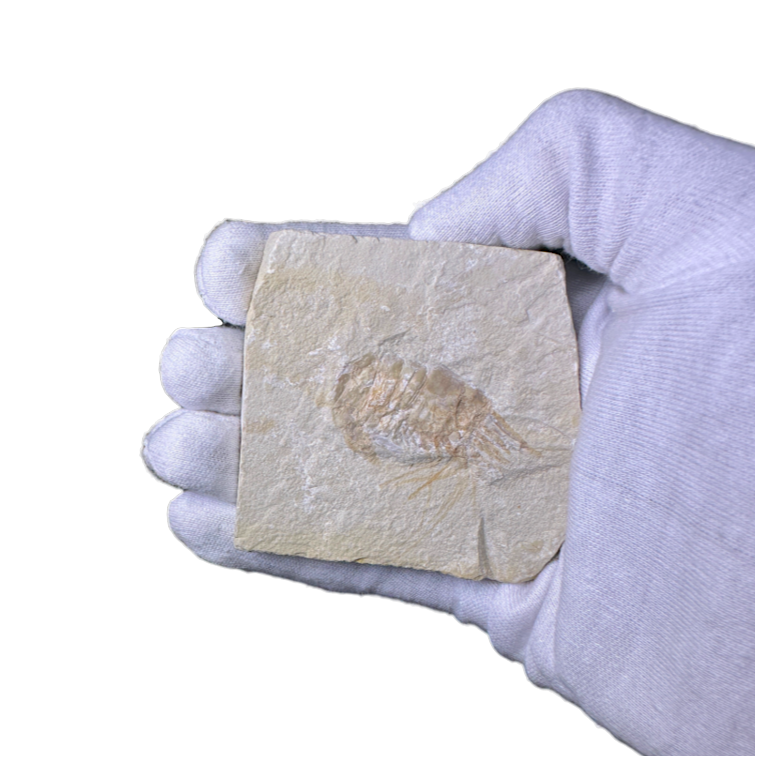
This fossil shrimp was recovered from the famous Solnhofen Limestone (Altmühltal Formation) near Eichstätt, Bavaria — a Late Jurassic (Tithonian, roughly 150 million years old) lagoonal deposit renowned as a Konservat-Lagerstätte for its exceptional preservation of soft tissue. The fine-grained lithographic limestone formed in oxygen-poor lagoon basins where a lack of scavengers allowed delicate crustacean exoskeletons, legs and antennae to fossilise in remarkable detail. Fossil shrimp of this type, commonly assigned to genera such as Aeger or Antrimpos, are relatively frequent finds within these deposits and share the same locality as world-famous fossils like Archaeopteryx and early pterosaurs.
A genuine fossil shrimp preserved in fine lithographic limestone from the world-renowned Solnhofen deposits of Eichstätt, Germany. This is an authentic natural specimen, recovered directly from the Jurassic lagoon sediments rather than reproduced or artificially enhanced in any way — exactly as it was found in the quarry, prepared to reveal its delicate outline.
The shrimp's body, legs and fine antennae are captured in soft ochre tones against the pale limestone matrix, a testament to the calm, low-oxygen lagoon conditions that allowed such fragile creatures to be preserved instead of scavenged or decomposed nearly 150 million years ago.
- Weight: 96g
- Matrix dimensions: approx. 7.5 x 1 x 6.5 (cm)
- Locality: Eichstätt, Solnhofen Limestone, Bavaria, Germany
- Age: Late Jurassic (Tithonian)
- Genuine, natural fossil — not a cast or replica
A striking piece for fossil collectors, educators or anyone drawn to the extraordinary preservation quality of the Solnhofen lagerstätte, this specimen makes a fine addition to any natural history display.
Share