

SKU:FOS-26-0842
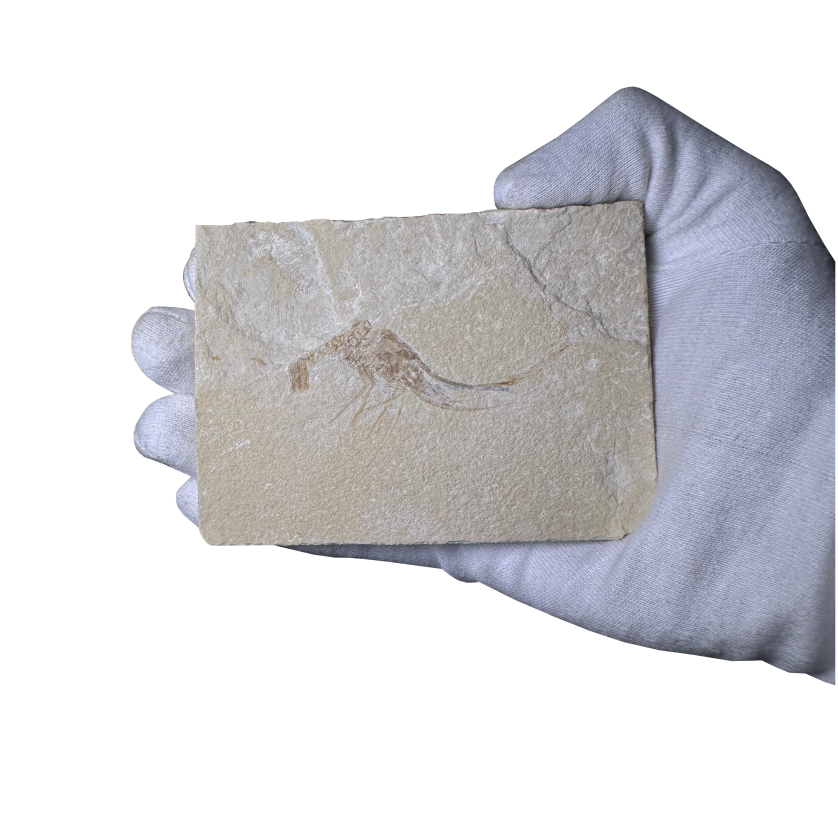
Shrimp Fossil
Shrimp Fossil
1 in stock
Couldn't load pickup availability
✔ Usually ready in 24 Hrs. View Store Information
Size: 10 X 1 X 8.5 cm
Weight: 161 Gram
Location: Germany
Product Description
This specimen preserves fossil shrimp of the genus Carpopenaeus, an extinct decapod prawn known from the Upper Jurassic through Cretaceous periods. It comes from the famous Cenomanian-age (Upper Cretaceous, roughly 95–100 million years old) limestone deposits of Lebanon, in the Hjoula–Haqel–Nammoura fossil belt northeast of Beirut. These fine-grained, lithographic-quality limestones formed in a warm, shallow Tethyan sea and are renowned for capturing soft-bodied marine creatures in exceptional anatomical detail, including the shrimp's carapace, segmented abdomen, legs and antennae. The matrix itself is a calcium carbonate sedimentary rock (hardness approx. 3 on the Mohs scale).
A beautiful slab of pale, fine-grained limestone holding not one fossil shrimp, delicately preserved in the rock exactly as nature left them nearly 100 million years ago. Their curved bodies, tapering tails and faint antennae trails are still visible against the soft tan stone, alongside natural bedding lines that hint at the quiet seafloor where they once settled.
- Weight: 161 g
- Dimensions: 10 x 1 x 8.5 cm
- Origin: Upper Cretaceous limestone beds of Lebanon (Hjoula–Haqel–Nammoura region)
- Contains two visible shrimp fossils (Carpopenaeus sp.) on the same plate
This is a genuine natural fossil recovered directly from the limestone quarries of Lebanon, not a cast, replica or artificially enhanced reproduction — the shrimp you see are the real, mineralised remains of ancient marine crustaceans, preserved in their original stone matrix.
A wonderful centrepiece for a fossil collection, a natural history display, or as a genuinely rare and conversation-starting gift for anyone drawn to deep time and the story written in stone.
Note: as with all natural fossils, the matrix carries its own texture, hairline marks and minor edge irregularities from the excavation process — these are part of its authentic, one-of-a-kind character rather than damage.
Share